
The deal your notes already have
If you keep your notes in plain Markdown files, you already know the deal: the app is a window onto files you can open in anything, copy anywhere, and keep forever — with or without that app. No export dance, no "your trial has ended," no wondering what happens to five years of work if a company changes its pricing.
Structured data — the tables, records and relations you'd normally reach for a "real" database or a spreadsheet tool for — has never really had that deal. It lives behind a login, in someone else's cloud, in a format only their app understands. dbcool is our attempt to give it the same deal.
What that actually means
- One file, and it's a real one. A dbcool workspace is a single
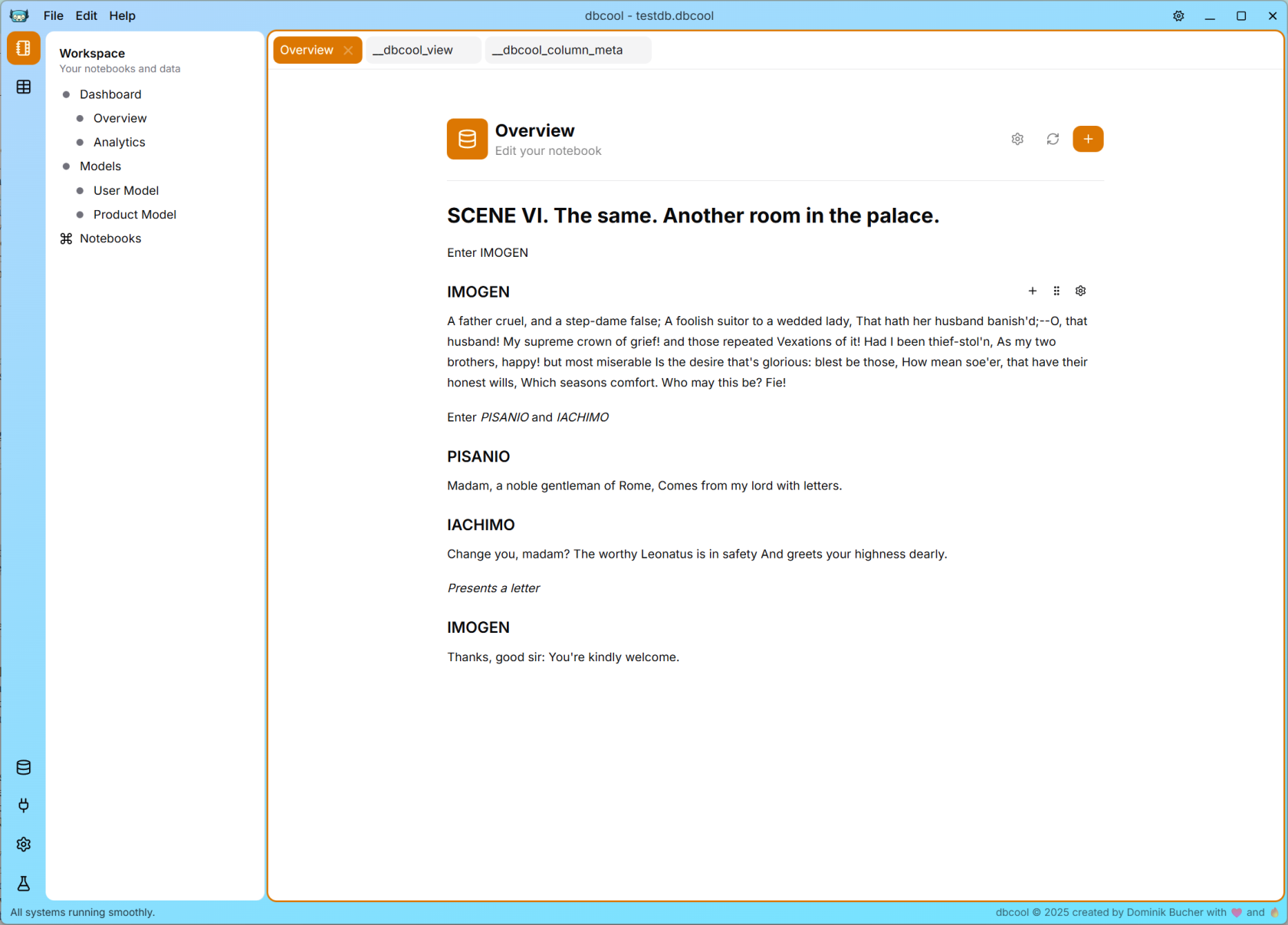
.dbcoolfile — SQLite underneath, openable by any SQLite tool that exists, not just ours. Copy it, back it up, put it in Git, move it to a new machine by moving a file. - Tables and notebooks in the same place. Structured records and the Markdown write-up that explains them live in one file instead of two disconnected tools you have to keep in sync yourself.
- Free, forever, on your machine. No account, no telemetry — nothing has to leave your computer unless you choose to share it.
- It grows with you, not with the vendor's roadmap. A plugin system lets you add custom cell types and full-page tabs — write one once, drop it into any
.dbcoolfile.
Why this matters more for structured data, not less
Notes are forgiving — worst case, a lock-in format is annoying to migrate out of. Structured data is where the lock-in actually hurts: it's your customer list, your inventory, your research measurements, the spine of whatever you're building. That's exactly the data you want in a format you can still open in ten years, with or without us.
That's the whole pitch. Everything else — the table editor, the notebooks, the plugins — is in service of that one file staying genuinely yours.